




When people think about fashion's environmental impact, they usually think about fabrics, production, or transportation. Packaging rarely enters the conversation. Yet every product is shipped in something. Every box, envelope, pouch, tissue paper, or shopping bag requires raw materials, manufacturing, transportation, storage, and eventually disposal. While packaging may represent a smaller share of a product's total carbon footprint than production, its impact grows with every shipment. As e-commerce continues to reshape retail, packaging has become one of the industry's fastest-growing environmental challenges. The question is no longer whether a product should be packaged, but how.
Choosing a more sustainable material is only one part of the answer.
The way people interact with packaging matters just as much. A package designed to be reused may have a lower long-term impact than one made from a technically "better" material that is immediately discarded. Material choice, durability, logistics, customer behavior, and even storage all become part of the same environmental equation.
This way of thinking has shaped how we approach packaging at Reflect Studio.

Over the years, we have continuously questioned not only what we use, but why we use it. Last year, we redesigned our retail shopping bags after realizing that customer behavior was just as important as material selection. In 2025, as we expanded into corporate gifting, packaging became an even larger part of the product experience. Rather than treating it as an accessory, we approached it as another design decision.
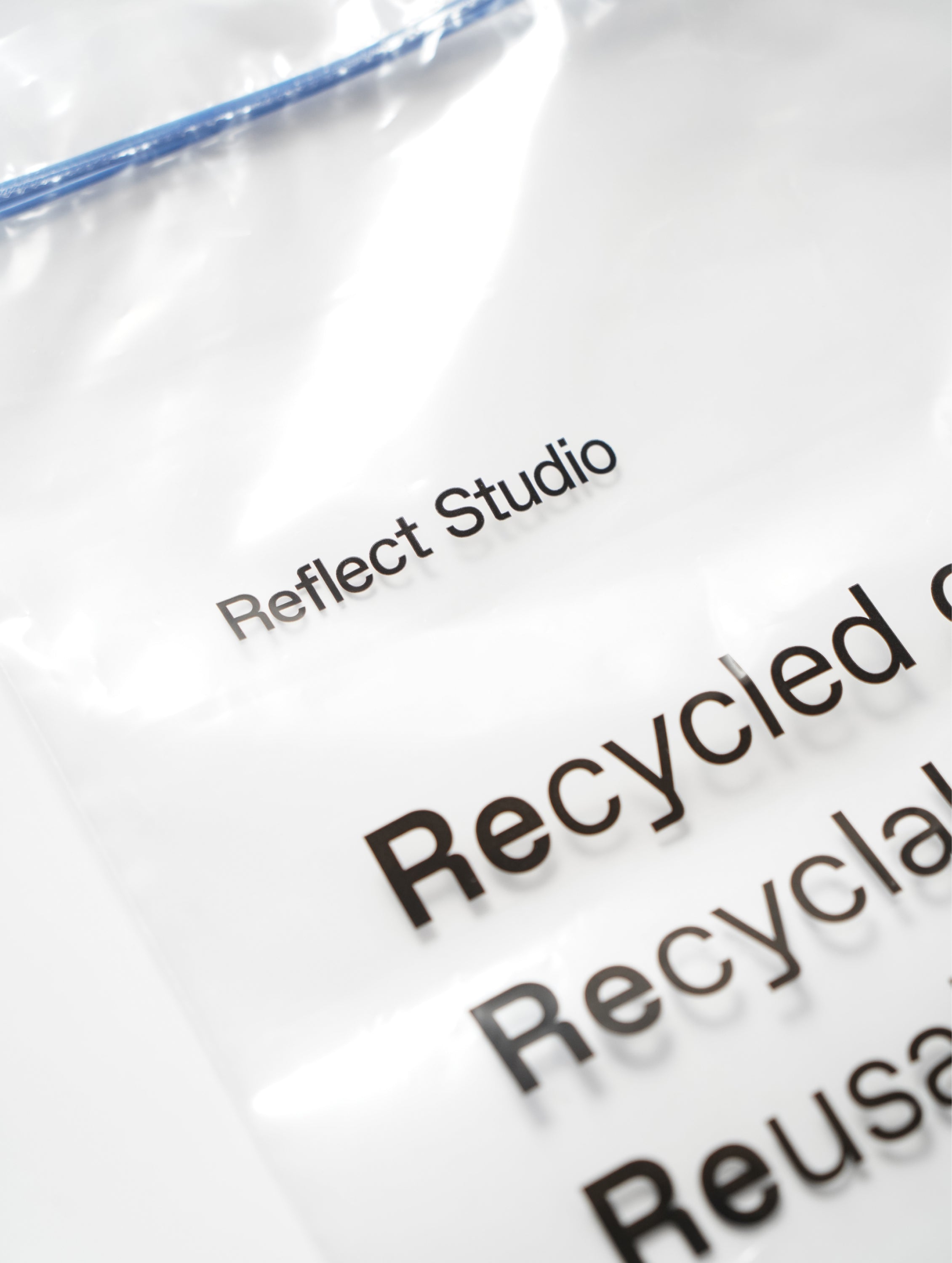
Today, our packaging system includes reusable zip-lock bags made from post-consumer recycled plastics for online orders, FSC-certified gift boxes for corporate gifting, kraft envelopes, and other responsibly sourced packaging materials selected according to different use cases. At the same time, we have started measuring packaging more closely. In our 2025 carbon footprint assessment, packaging-related materials accounted for a measurable share of our Scope 3 emissions. Kraft envelope packaging represented 12.18%, reusable pouches 3.42%, FSC-certified gift boxes 0.58%, alongside tissue paper and office paper consumption.
These numbers are not just statistics. They help us understand where impact exists and where improvement is possible.
For us, sustainability is rarely the result of a single big decision. It is built through hundreds of smaller ones.
Packaging happens to be one of them.